


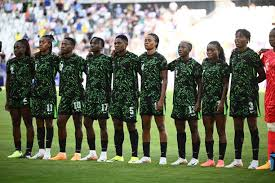
It began, as many things in football do, with applause and pretense.
The 2030 African Nations Cup, hosted in Lagos and Abuja, was billed as a diplomatic festival, a chance to showcase Nigerian hospitality, cultural finesse, and, above all, Africa’s evolving sporting conscience. Both the men’s and women’s tournaments ran concurrently: a rare feat, and, on paper, a progressive one.
But on the night Morocco’s women’s team took the field against Nigeria’s Super Falcons in the quarterfinals, progress dimmed—quite literally—beneath the harsh geometry of laser lights.
From the stands, discreet green beams danced across Moroccan jerseys, then foreheads, then retinas—a flicker here, a pulse there. At first, incidental. Later, systematic.
By the second half, every set piece was preceded by a constellation of light. Subtle, but not subtle enough. The fourth official pretended not to see the provocation. The broadcasters kept their angles wide. Morocco lost on penalties.
The delegation protested formally. They called it “optical sabotage.” Their coach described the experience as “playing football inside a science laboratory.” One player claimed her vision blurred at the critical moment. Meanwhile the Nigerian crowd considered the spectacle “retributively remarkable.”
When pressed, a member of the local organizing committee, Mr Akinjide Affiong, reportedly said: “The fans were only enjoying themselves. These things are not really big deals. They happen everywhere.”
Fast forward to Abuja, a worse episode of disruption happened during the men’s tournament. After Nigeria’s early stumble in the opening match, Ivory Coast’s team bus was ambushed on its way back to the hotel. The windscreen was shattered. Two players sustained minor injuries. The driver, in shock, veered into a security barricade. It’s been forty-eight hours since the incident broke. There have been no arrests, and the Nigerian officials who condemned the violence did so while quietly legitimizing it.
“Emotions were high,” one noted. “Nigeria is a passionate footballing country,” another said. Violence, of course, is a passionate expression.
As expected, both the Moroccan and Ivorian teams filed reports. The reports were received. Again, as expected, no action followed.
The Archive
It would be tempting—easy, in fact—to treat these incidents as outliers; the result of unchecked exuberance! But that would require forgetting the precise symmetry of recent history.
In the run-up to the 2025 Africa Cup of Nations qualifiers, Nigeria’s Super Eagles endured abuse of a different but no less consequential sort. Upon arrival in Libya for their match, the team’s chartered flight was diverted without explanation to an airport hundreds of kilometers from their destination.
There, they were stranded for over twelve hours. Locked in the terminal without food, water, transport, or official assistance. Players described the experience as psychological warfare.
The Nigerian Football Federation filed a formal protest and refused to play. CAF later ruled in Nigeria’s favour, awarding a 3–0 victory and fining the Libyan FA. The punishment, though symbolic, did little to erase the bitter impression.
Less than a year later, at the 2024 Women’s Africa Cup of Nations in Morocco, the Super Falcons faced a quieter, brighter form of disruption. Laser pointers from the Rabat stands tracked their movements like hostile satellites. Esther Okoronkwo was seen shielding her eyes before a decisive penalty. Regardless, the stargirl scored. The Falcons won. The world moved on, ignoring the bruised snake.
In Yoruba tradition, the bruised snake is a warning that a wounded force may return more lethal. That is the avoidable lesson now reinforced by Nigeria’s retaliatory attacks on Morocco and Ivory Coast. The bruised snake returned with unconscionable venom, and the cycle completed itself.
None of this, of course, absolves Nigeria. A stadium is not a courtroom for retribution. Violence is not softened by historical recourse. What occurred in Lagos and Abuja—both on and off the pitch—was unsporting. The aesthetic difference between retaliation and regression is, at best, academic.
But the incidents offer something rarer than scandal: a parable that exposes how impunity becomes an invitation to savagery! How injustice, unanswered, incubates mimicry! How football, like history, returns the things we bury—often with interest.
The Moroccan Football Federation as well as her Ivorian counterpart is now calling for CAF reform, demanding stricter enforcement, in the interest of what they describe as “pan-African consistency.”
One is tempted to agree.
But had the beam not changed direction—had the bus not changed nationality—would we be reading formal statements, or just another euphemism?
Nigerian authorities must now reckon with the embarrassment of hosting a tournament that devolved into a referendum on historic hostility against its own continental kin.
Anyways, the organizers will apologize—again, no doubt. Penalties may follow. But the truest test lies not in punishment, but in prevention.
In the end, the lesson is elementary: in football, as in politics, light reveals, and just as often, it reflects the darkness within.
Majekodunmi Oseriemen Ebhohon is a poet, media practitioner, writer, and playwright. He is the author of a Black revolutionary play, ‘The Great Delusion’, and writes from Benin City, Edo State, Nigeria (West Africa).
sankara101010@gmail.com
+234 (0) 9139208624
Leave a Reply