


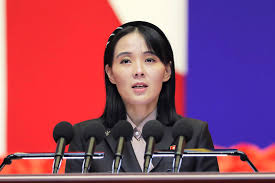
The powerful sister of North Korean leader Kim Jong Un criticized the United States and South Korea for proceeding with their annual joint military exercises at a perilous moment for global security and warned that any challenge to the North’s safety would bring “terrible consequences.”
Kim Yo Jong’s statement Tuesday came a day after the allies started their 11-day Freedom Shield exercise involving thousands of troops, while Washington also wages an escalating war in the Middle East.
Without directly referring to the Iran war, Kim said the U.S.-South Korea drills undermine regional stability at a time when the global security structure is “collapsing rapidly and wars break out in different parts of the world due to the reckless acts of outrageous international rogues.”
Freedom Shield is one of two annual command-post exercises conducted by the U.S. and South Korean militaries. The largely computer-simulated drills are designed to test the allies’ joint operational capabilities while incorporating evolving war scenarios and security challenges. As usual, Freedom Shield will be accompanied by a field training program, called Warrior Shield.
Mentioning the country’s expanding nuclear program, Kim Yo Jong said North Korea will continue to bolster its “destructive power” against what it sees as external threats and “constantly and repeatedly convince the enemies of our war deterrence and its fatality.”
North Korea has long portrayed the allies’ joint drills as invasion rehearsals and often used them as a pretext to ramp up its own military demonstrations or weapons tests. The allies say the exercises are defensive in nature.
Meanwhile, South Korean President Lee Jae Myung acknowledged “some anti-defense weapons” could be relocated by the U.S. but said such moves wouldn’t seriously undermine defenses against North Korea. His comments followed media speculation that the United States was moving some Patriot missile defense systems and other equipment from South Korea to support operations in the Middle East.
“Our government has expressed opposition to such moves, but it’s also an undeniable reality that we cannot fully control the situation according to our wishes,” Lee said at a Cabinet meeting.
North Korea’s Foreign Ministry last week described the U.S. and Israeli attacks on Iran as an “illegal act of aggression” carried out under the pretext of “fake peace.”
Amid a yearslong diplomatic freeze with Washington and Seoul, Kim Jong Un has increasingly framed his foreign policy around the idea of a new Cold War, deepening ties with Moscow and Beijing while portraying Pyongyang as part of a united front against Washington.
Pyongyang and Tehran were among the few governments to support Russian President Vladimir Putin’s invasion of Ukraine, and both have been accused of supplying Russia with military equipment.
Separately, South Korea’s Unification Ministry said it believes train services between Pyongyang and Beijing will resume this week for the first time in six years after being suspended during the COVID-19 pandemic. North Korea and China had already resumed rail operations between border towns, mainly for trade, after the North began easing border restrictions in 2022. It remains unclear whether the renewed services between their capitals will result in increased exchanges, including tourism in North Korea.
While prioritizing Russia in foreign policy, Kim has also sought to strengthen ties with China, the North’s traditional main ally and economic lifeline. He traveled to Beijing last September and held his first summit with Chinese President Xi Jinping in six years.
—AP