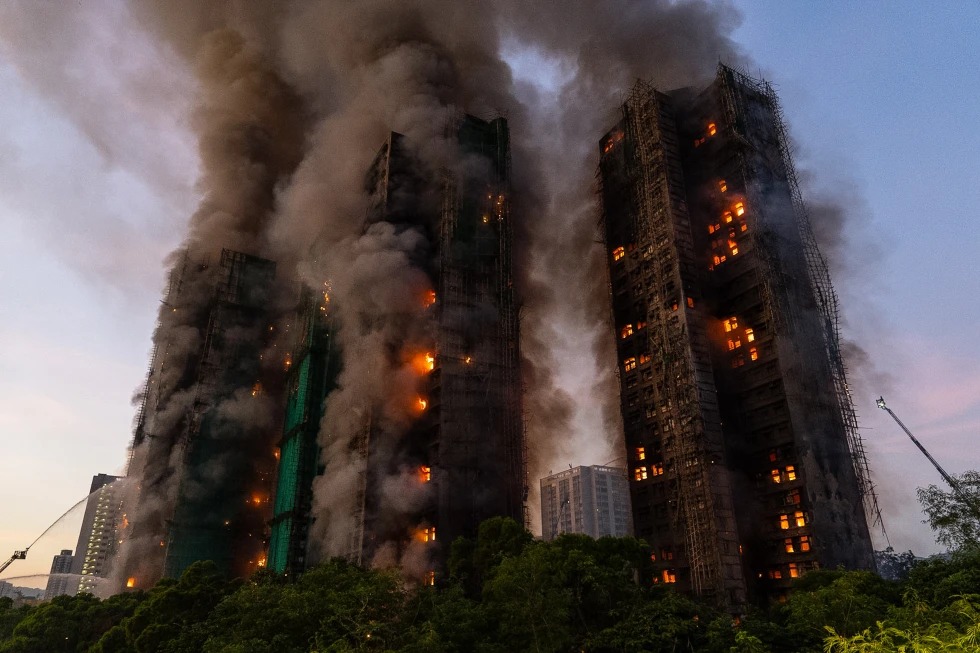
When Hong Kong was hit by its deadliest fire in decades last year, it left thousands of residents without some of their friends, family or the place they called home.
More than two months later, the occupants of the Wang Fuk Court apartment complex are waiting not just for answers about what happened, but also a new place to live.
Authorities are yet to unveil plans for long-term resettlement after surveying the residents’ preferences. The Lunar New Year on Feb. 17, meanwhile, is stirring recent memories of celebrating the festival in what is now a largely burnt-out residential complex in the suburban district of Tai Po.
The massive blaze engulfed seven apartment buildings and killed 168 people on Nov. 26, 2025, shattering a close-knit community. Authorities blamed substandard scaffold netting and foam boards used in a maintenance project for rapidly spreading the fire. Although some arrests were made, an independent committee is still investigating the cause.
The Associated Press talked to four families who lived in the complex or lost loved ones there. Here’s what they said:
No place to call home
When flames devoured the towers of the Wang Fuk Court complex, Pearl Chow, 87, fled her apartment with essential documents like her title deed. Her grandson, Dorz Cheung, 33, rushed from his office to find her safe nearby while the fire was still raging.
That night, Chow went to a friend’s home and didn’t sleep, while Cheung watched the flames for hours, crying while clutching a friend. They both miss old photos lost in the fire.
Now they are separated into two temporary housing units on separate floors, each around 100 square feet (9.2 square meters). Chow says she’s satisfied, but Cheung says it’s not a home.
“Only a permanent residence can be a home,” he said.
Chow still regularly returns to Tai Po for church and grocery shopping, despite the hourlong journey. They want to be resettled in Tai Po, where they lived for decades, in a unit about the same size as their old apartment.
“I am an elderly person. When they finish building, I may have gone to my heavenly home,” she said with a laugh.
Data from the 2021 population census showed over one-third of the complex’s approximately 4,600 residents were aged 65 or above.
Cheung said he lost his sense of security with the authorities after the blaze. The government proposed measures to combat bid-rigging in building maintenance and enhance fire safety in January, but Cheung says it still hasn’t addressed resettlement.
“We can only wait, being tossed around like a ball,” he said.
A temporary refuge
Kit Chan, 74, lived with her husband in a 460-square-foot (43-square-meter) apartment for over 40 years, raising their family in a community where neighbors helped look after each other’s children.
Chan planned to spend the rest of her life there, but the blaze forced the couple into a studio unit at a youth hostel half the size of their apartment. Weeks ago, they heard that other fire victims were being asked to move out of the hostel.
She hasn’t been asked to leave, but it’s got her worried about what comes next. “It’s like being unable to get by in my final years,” she said.
Chan initially wanted to be resettled in a new home built on the fire site, but the government estimates that rebuilding will take about a decade. Now she says she could accept a similar-sized apartment in another district with good transport.
Her husband, Keung Mak, 78, hopes they can return to their old home just to have a look.
It has memories like their family and wedding photos. “Many people hope they can at least see how badly it was burned,” Mak said.
Weighing time against place
During past Lunar New Year celebrations, Isaac Tam’s family used to visit neighbors on their floor with gifts. Now, the familiar faces he has known for years are scattered across the city.
The loss of their two apartments in the fire was heartbreaking. His parents cried, and his 92-year-old grandfather grew thinner. But Tam, 23, said at least all his family members were alive.
Last weekend, they were preparing to move into temporary homes, smaller than their old apartments and farther from the city center. They shelled out money to renovate them.
While he says the government’s handling is not as bad as some say, he worries about how his grandfather will adjust to temporary housing in a new district. Back in Tai Po, the grandfather used to have a morning dim sum routine with his friends.
As they await the government’s resettlement plans, they have been weighing apartments in another district that could be ready sooner than units in Tai Po, which he prefers because he grew up there.
Time is their priority, given his grandfather’s age, Tam said.
“I fear he can’t wait until we secure an apartment of about 400 square feet (about 37 square meters),” he said, regardless of the district.
Grieving for mother and hanging on to memories
Phyllis Lo’s mother called her after seeing thick smoke outside her door when the blaze started. On the call, knowing she might not survive, her 74-year-old mother asked Lo, 48, and her brother to live well. Lo immediately rushed to her childhood home and called again minutes later. No one answered. The next morning, police told her they had found her mother’s body.
After learning that a mix of issues including substandard materials were used in the building maintenance project and failed fire alarms, Lo wondered if the tragedy could have been avoided if government departments had done a better job. While she doesn’t who should bear responsibility, she blamed herself for not monitoring the project for her mother more closely.
What bothers her most is the lack of transparency — when she can see her burnt apartment, how authorities will use the $589 million relief fund. She hopes to get updates from the nine-month investigation.
She wants her childhood home rebuilt at the fire site, but considers the proposed timeline of about a decade unreasonably long.
As the Lunar New Year neared, Lo made turnip cakes — a tradition she inherited from her mother. “Maybe she is still everywhere and still seeing us now. I really want to be with her,” she said in tears.
Rebuilding a community isn’t easy
Hong Kong leader John Lee said the city is working hard on a resettlement plan, but it’s a complicated matter. He added that a significant proportion of homeowners have indicated that they’d be willing to consider selling their ownership rights to the government.
“This is no easy time for families of Wang Fuk Court. The government will work tirelessly to finalize the plan as soon as possible,” he said at Tuesday’s press briefing.
Jack Rozdilsky, professor of disaster and emergency management at York University in Canada, said the city is moving to a disaster recovery phase and noted that concrete plans for continuous mental health and trauma coping aid will be key to a successful resettlement plan.
Rozdilsky saw the community survey on resettlement as a good sign because a one-size-fits-all proposal will not satisfy the households.
While rebuilding living spaces is complicated, he said, reconstructing a community is much harder. He said understanding what promoted community at the housing complex before the fire and incorporating those features — be it a bus stop or a gathering point in a park — would help.
“Very small things matter,” he said.
—AP