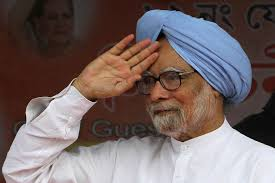
India’s former Prime Minister Manmohan Singh, widely regarded as the architect of India’s economic reform program and a landmark nuclear deal with the United States, has died at 92. According to the hospital statement, Singh was admitted to New Delhi’s All India Institute of Medical Sciences late Thursday after his health deteriorated due to a “sudden loss of consciousness at home. “Resuscitative measures were started immediately at home. He was brought to the Medical Emergency” at 8:06 p.m., the hospital added, but “despite all efforts, he could not be revived and was declared dead at 9:51 p.m.” Singh was being treated for “age-related medical conditions,” the statement said. The former P.M. became one of India’s longest-serving prime ministers for 10 years and leader of the Congress Party in the Parliament’s Upper House, earning a reputation as a man of great personal integrity. He was chosen to fill the role in 2004 by Sonia Gandhi, the widow of assassinated Prime Minister Rajiv Gandhi Singh was reelected in 2009, but his second term as prime minister was clouded by financial scandals and corruption charges over the organization of the 2010 Commonwealth Games. This led to the Congress Party’s crushing defeat in the 2014 national election by the Hindu nationalist Bharatiya Janata Party under the leadership of Narendra Modi. Singh adopted a low profile after relinquishing the post of prime minister. Prime Minister Modi, who succeeded Singh in 2014, called him one of India’s “most distinguished leaders” who rose from humble origins and left “a strong imprint on our economic policy over the years.” “As our Prime Minister, he made extensive efforts to improve people’s lives,” Modi said in a post on the social platform X. He called Singh’s interventions in Parliament as a lawmaker “insightful” and said “his wisdom and humility were always visible.” Rahul Gandhi, from the same party as Singh and the opposition leader in the lower house of the Indian Parliament, said Singh’s “deep understanding of economics inspired the nation” and that he “led India with immense wisdom and integrity.” “I have lost a mentor and guide. Millions of us who admired him will remember him with the utmost pride,” Gandhi wrote on X. The United States offered its condolences, with Secretary of State Antony Blinken saying that Singh was “one of the greatest champions of the U.S.-India strategic partnership.” “We mourn Dr. Singh’s passing and will always remember his dedication to bringing the United States and India closer together,” Blinken said. Born on Sept. 26, 1932, in a village in the Punjab province of undivided India, Singh’s brilliant academic career took him to Cambridge University in Britain, where he earned a degree in economics in 1957. He then got his doctorate in economics from Nuffield College at Oxford University in 1962. Singh taught at Panjab University and the prestigious Delhi School of Economics before joining the Indian government in 1971 as economic advisor in the Commerce Ministry. In 1982, he became chief economic adviser to the Finance Ministry. He also served as deputy chair of the Planning Commission and governor of the Reserve Bank of India. As finance minister, Singh in 1991 instituted reforms that opened up the economy and moved India away from a socialist-patterned economy and toward a capitalist model in the face of a huge balance of payments deficit, skirting a potential economic crisis. His accolades include the 1987 Padma Vibhushan Award, India’s second-highest civilian honor; the Jawaharlal Nehru Birth Centenary Award of the Indian Science Congress in 1995; and the Asia Money Award for Finance Minister of the Year in 1993 and 1994. Singh was a member of India’s Upper House of Parliament and was leader of the opposition from 1998 to 2004 before he was named prime minister. He was the first Sikh to hold the country’s top post and made a public apology in Parliament for the 1984 Sikh Massacre in which some 3,000 Sikhs were killed after then-Prime Minister Indira Gandhi was assassinated by Sikh bodyguards. Under Singh, India adopted a Right to Information Act in 2005 to promote accountability and transparency from government officials and bureaucrats. He was also instrumental in implementing a welfare scheme that guaranteed at least 100 paid workdays for Indian rural citizens. The coalition government he headed for a decade brought together politicians and parties with differing ideologies that were rivals in the country’s various states. In a move hailed as one of his biggest achievements apart from economic reforms, Singh ended India’s nuclear isolation by signing a deal with the U.S. that gave India access to American nuclear technology. But the deal hit his government adversely, with Communist allies withdrawing support and criticism of the agreement growing within India in 2008 when it was finalized. Singh adopted a pragmatic foreign policy approach, pursuing a peace process with nuclear rival and neighbor Pakistan. But his efforts suffered a major setback after Pakistani militants carried out a massive gun and bomb attack in Mumbai in November 2008. He also tried to end the border dispute with China, brokering a deal to reopen the Nathu La pass into Tibet, which had been closed for more than 40 years. His 1965 book, “India’s Export Trends and Prospects for Self-Sustained Growth,” dealt with India’s inward-oriented trade policy. Singh is survived by his wife Gursharan Kaur and three daughters.



Leave a Reply