


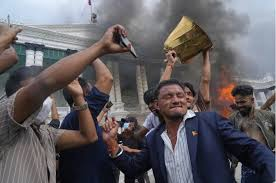
Nepal’s prime minister resigned Tuesday as protests against a short-lived ban on social media grew increasingly violent and expanded into broader criticism of his government and accusations of corruption among the Himalayan country’s political elite.
The resignation appeared to have little effect on the demonstrations. Tens of thousands of protesters remained on the streets late in the day, blocking roads, storming government buildings and setting them on fire, and, in some cases, attacking political leaders. Army helicopters ferried some ministers to safe places.
A day earlier, demonstrations led by young people angry about the blocking of several social media sites gripped the country’s capital, and police opened fired on the crowds, killing 19 people.
The ban was lifted Tuesday, but the protests continued, fueled by anger over the deaths and growing frustration with the political elite in the nation wedged between China and India.
As the protests intensified, Prime Minister Khadga Prasad Oli announced he was stepping down. The president accepted the resignation and appointed Oli to lead a caretaker government until a new one is in place — though it was unclear what power he would wield or even where he was.
The army issued a statement calling for calm and urging political dialogue, but did not give any other details.
Focus turns to the government
The demonstrations — called the protest of Gen Z — began after the government blocked platforms, including Facebook, X and YouTube, saying the companies had failed to register and submit to government oversight.
But they spiraled to reflect broader discontent. In particular, many young people are angry that the children of political leaders — so-called Nepo Kids — seem to enjoy luxury lifestyles and numerous advantages while most youth struggle to find work. With youth unemployment running at about 20% last year, according to the World Bank, the government estimates that more than 2,000 young people leave the country every day to seek work in the Middle East or southeast Asia.
“I am here to protest about the massive corruption in our country,” said Bishnu Thapa Chetri, a student. “The country has gotten so bad that for us youths there is no grounds for us to stay.”
Videos shared on social media showed protesters beating up Nepali Congress party leader Sher Bahadur Deuba and his wife, Arzu Rana Deuba, the current foreign minister. Both appeared to be bleeding, while one video showed the party leader being helped to safety. The party is the country’s largest and is part of the governing coalition.
Local media and videos on social media also showed protesters attacking government buildings and the residences of the top political leaders throughout Tuesday.
The presidential palace, the prime minister’s official residence, and a building that houses the offices of the prime minster and several ministries were all torched. Thick smoke rose from the prime minister’s office building.
Earlier, Oli’s private home was set on fire, as were those of the president, home minister and the Deubas. The home of the leader of the opposition Communist Party of Nepal (Maoist) was also set ablaze.
Some protesters blamed the government for the police opening fire and called for the ouster of the increasingly unpopular prime minister.
“We are here to protest because our youths and friends are getting killed, we are here to see that justice is done and the present regime is ousted,” said Narayan Acharya, who was among the protesters outside the battered wall of the parliament building Tuesday. “K.P. Oli should be chased away.”