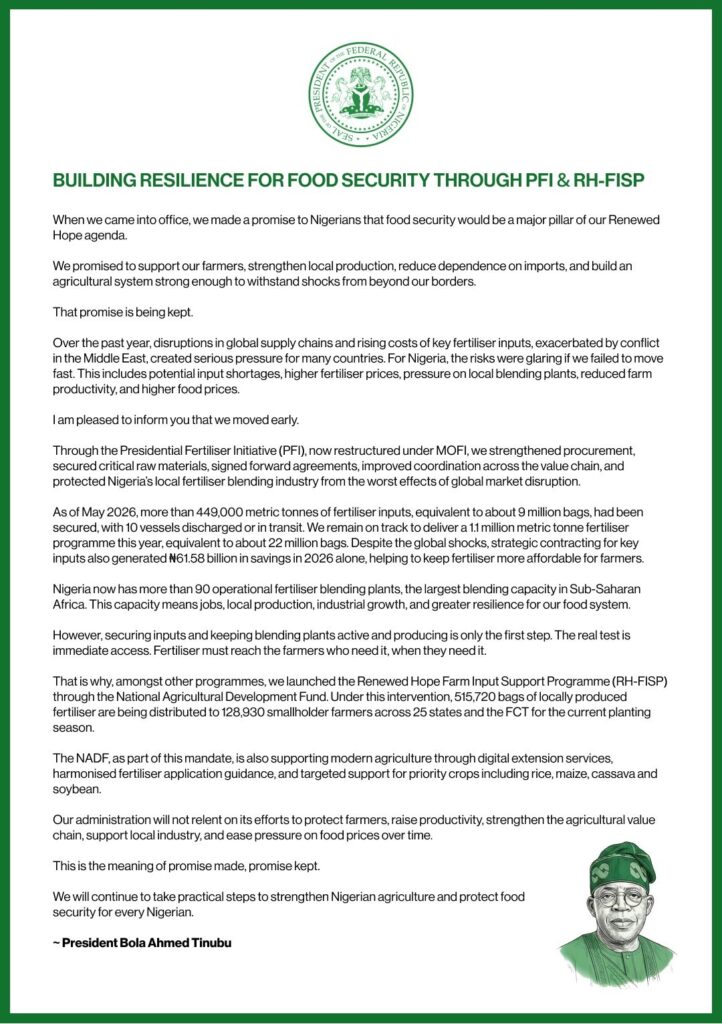
President Tinubu: “When we came into office, we made a promise to Nigerians that food security would be a major pillar of our Renewed Hope agenda.
“We promised to support our farmers, strengthen local production, reduce dependence on imports, and build an agricultural system strong enough to withstand shocks from beyond our borders. That promise is being kept.
“Over the past year, disruptions in global supply chains and rising costs of key fertiliser inputs, exacerbated by conflict in the Middle East, created serious pressure for many countries. For Nigeria, the risks were glaring if we failed to move fast.
“This includes potential input shortages, higher fertiliser prices, pressure on local blending plants, reduced farm productivity, and higher food prices.I am pleased to inform you that we moved early.
“Through the Presidential Fertiliser Initiative (PFI), now restructured under MOFI, we strengthened procurement, secured critical raw materials, signed forward agreements, improved coordination across the value chain, and protected Nigeria’s local fertiliser blending industry from the worst effects of global market disruption.
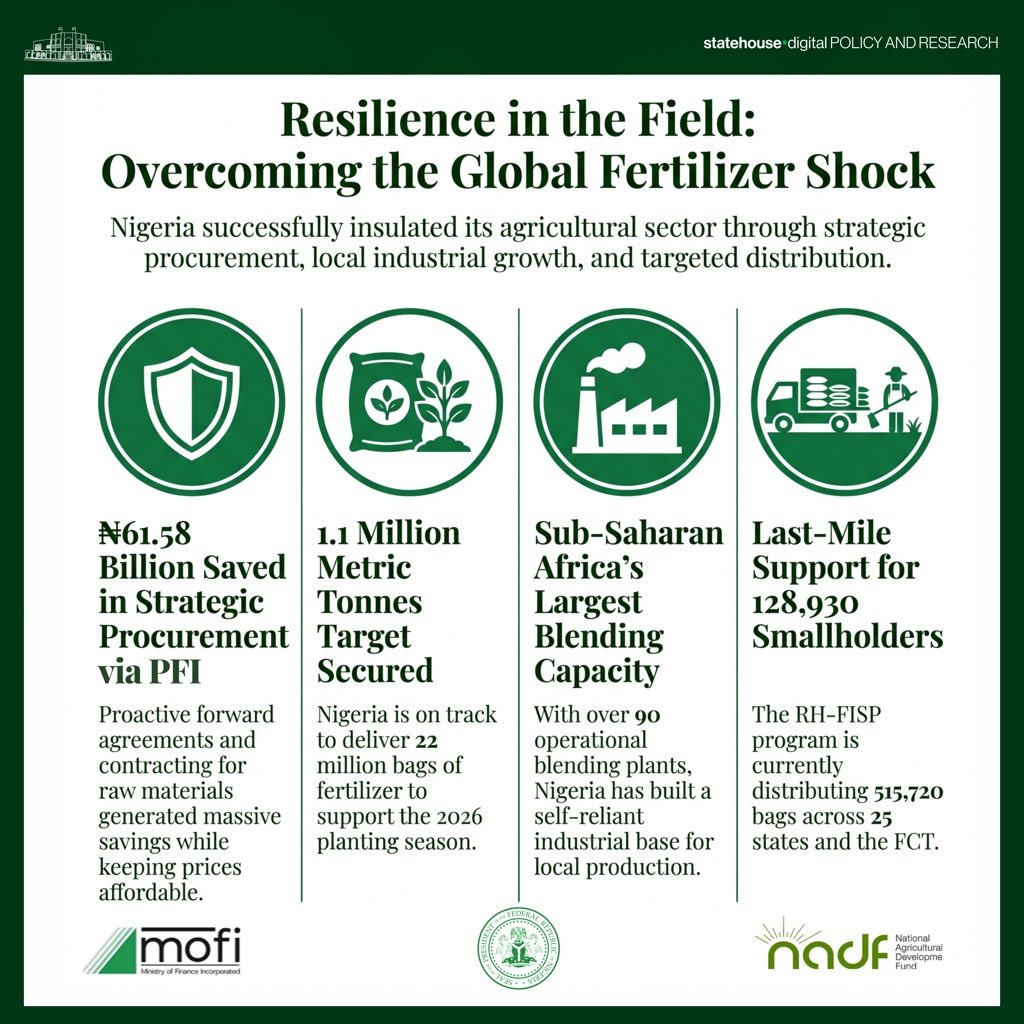
“As of May 2026, more than 449,000 metric tonnes of fertiliser inputs, equivalent to about 9 million bags, had been secured, with 10 vessels discharged or in transit.
‘We remain on track to deliver a 1.1 million metric tonne fertiliser programme this year, equivalent to about 22 million bags. Despite the global shocks, strategic contracting for key inputs also generated ₦61.58 billion in savings in 2026 alone, helping to keep fertiliser more affordable for farmers.
“Nigeria now has more than 90 operational fertiliser blending plants, the largest blending capacity in Sub-Saharan Africa. This capacity means jobs, local production, industrial growth, and greater resilience for our food system.
“However, securing inputs and keeping blending plants active and productive, is only the first step. The real test is last-mile and immediate access. Fertiliser must reach the farmers who need it, when they need it.
“That is why, amongst other programmes, we launched the Renewed Hope Farm Input Support Programme (RH-FISP) through the National Agricultural Development Fund. Under this intervention, 515,720 bags of locally produced fertiliser are being distributed to 128,930 smallholder farmers across 25 states and the FCT for the current planting season.
“The NADF, as part of this mandate, is also supporting modern agriculture through digital extension services, harmonised fertiliser application guidance, and targeted support for priority crops including rice, maize, cassava and soybean.
“Our administration will not relent on its efforts to protect farmers, raise productivity, strengthen the agricultural value chain, support local industry, and ease pressure on food prices over time.
“This is the meaning of promise made, promise kept. We will continue to take practical steps to strengthen Nigerian agriculture and protect food security for every Nigerian.”